Quite a few years ago when I was having yet another MFM (Mom Failure Moment), I wrote this under the inspiration of the poem A Visit from Saint Nicholas. With a few edits, here it is again for Christmas 2023. May you have a joyful and as-relaxed-as-possible Christmas!
It was recently brought to my attention (again) that there are quite a few people who argue against Christianity because they can’t understand why an allegedly loving God sends people to Hell. So, I just want to clear this up:
God doesn’t send anyone to Hell.
Really. Hear me out –
Let’s start with a brief rundown of Plan A: God created a perfect world designed to meet all human needs, gifted humans with the ability to make their own decisions, gave clear and simple Instructions on easy Perfect World Maintenance (along with an explanation of what would happen should Maintenance fail), and offered a loving family relationship with Himself providing the highest level of Interpersonal Support to keep things running along. God’s Plan A was for this arrangement to continue as it was enjoyable for Him and very beneficial to the children He loved – but He had, as stated, created independent beings with decision-making powers, and they chose (and still do) to ignore the Instructions, reject the Support, and rebel against the family. So Maintenance failed, and the world and humanity (as foretold in the Maintenance Instructions) began falling into increasing levels of disrepair.
At this point, there is no maintenance and no good deeds, personal or environmental or otherwise, that will reverse the damage. But that’s ok, because God still loves humans and enacted Plan B. The only permanent salvation from the consequences of our own poor decisions lies in each of us making a better one: Instead of remaining separated from God, we can choose to accept His promises through His Son and regain a personal relationship with God. This does not make life perfect here on earth because the decision is individual, not global, so the world will continue to flounder and slide into disrepair and we still have to deal with it. But God is the creator and giver of all good things so choosing God does provide an amazing relationship with Him, a remarkable guide for living, incredible relief, and the promise of a future. You’ve heard of faith? This is it.
Where does that leave those who are concerned with God sending people to Hell?
Well, we each get to decide what to do about God’s offer of a relationship. He takes all comers but He doesn’t choose for you. Our parents and life situations are certainly an influence, but ultimately each person has the option to be near God or not. Those who elect to remain separate from Him do not enter Heaven since that is God’s home and they have chosen not to be near Him. Although God is grieved by this, He does not go against their choice. Hell is the place of separation from God and thus is the voluntary eternal landing zone for those who decide against God. And, yes, the Bible clearly states that suffering is involved with that choice because God is the only giver of all good, so to separate from God is to separate from everything good, and Hell is what remains – but going to Hell is still a choice anyone can make. Going to Heaven is also a choice anyone can make, and God is delighted to take anyone who wants to come.
As parents of special needs children, we are undoubtedly our own harshest critics. We waste much of our thought time and precious energy debating the past – wondering if we could have or should have done a thing differently, taken a different approach, persisted more in some areas, less in others. Our own self-castigating voices rumble in the back of our minds questioning and regretting past actions even as we strive to live positively in the present and do our best to help establish viable futures for our loved ones. It’s a big load to carry.
I believe time travel shows such as Back to the Future and Doctor Who are popular because they feed the desire to change past choices that may (or may not) have ended better so we might no longer struggle with guilt or shame over decisions that can never be changed. In my own struggle with self-forgiveness, I have learned this: If we are truly to receive the grace God offers, embrace the present and move forward in hope and joy, we must give up hope for a better past.
We are, in fact, our own worst enemies in terms of grace. God’s command for us to love others as He loves us (John 13:34) indicates that He intends us to walk in compassion and mercy with those around us. In Mark 12:30-31 and Leviticus 19:18, God’s command extends to us loving others as we love ourselves, a clear indication for each of us to accept that we are no less a recipient of His mighty grace than anyone else.
I must point out here the obvious truth that most of us find it much easier to forgive others than to forgive ourselves. And yet, who are we to refuse forgiveness to anyone, including ourselves, where God has so graciously given it? Are we above Him in any way? Is it our job to second-guess his judgement and mercy? Where God forgives, we are to forgive – including ourselves. If our repentance over wrong actions is real, then the release of God’s freely given grace should be directed inward as well as outward.
The gritty inner voices of self-recrimination just slow us down. The truth is that memories of things said and done will always be with us – the wonderful, powerful times as well as the dark moments and heinous mistakes. As difficult as it may be for us to let go of that which we cannot change, it can be done and – for the benefit of our special loved ones, all those we care for, and even ourselves – it should be done. With God’s help, we can learn to allow the darkness of past regret to drop away and choose the hope, clarity, and peace that He has for each of us.
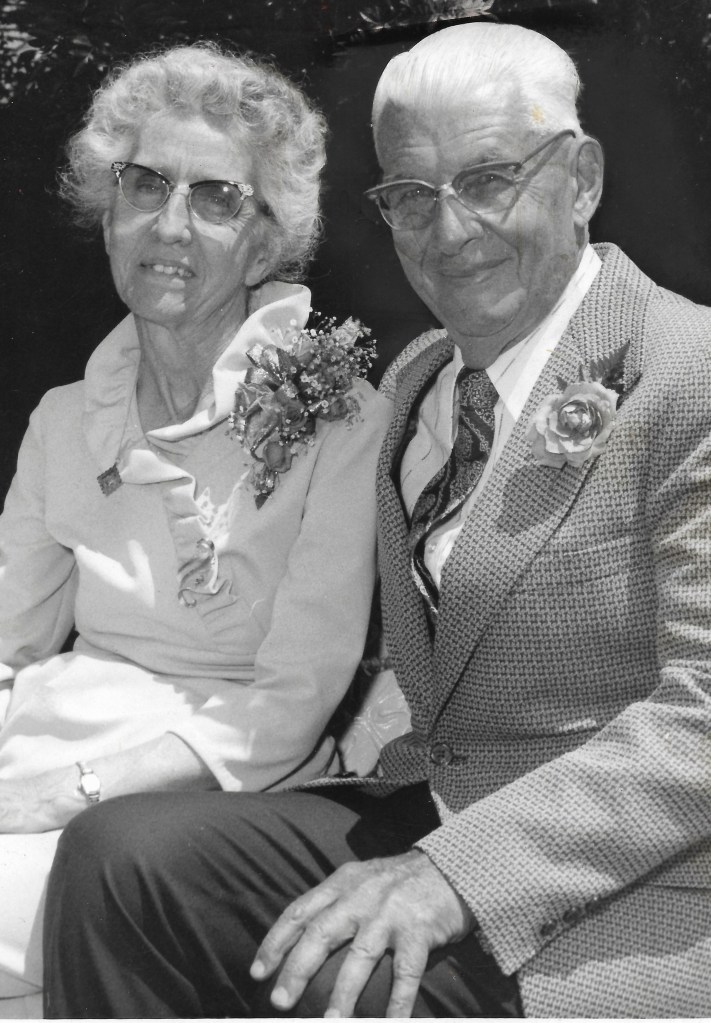
Today, I was reminded of the importance of keeping love and passion alive within. While sorting documents, I found this letter I wrote in 1989 in memory of my maternal grandparents. The memory of their faith and love lives in my heart.
Dear Grandpa and Grandma,
Keith & Lela’s Wedding Photo, 1924
I am writing this letter to you and sharing it with family and friends because I had to put into words what I learned from your lives. I’m sorry I didn’t understand it well enough to tell you when you were here, but maybe I didn’t know it then.
To live is to age. You taught me not to fear either.
Lela Mabry, c. 1922
A few years ago, Grandma, you told me about the time very recently when you were scrubbing the church floor with other women in the church. You felt a little faint from the odor of ammonia and stood for a moment, leaning against the wall. A younger woman came up and said, “Mrs. Roper, are you all right?” And you thought to yourself, “Good heavens, she thinks I’m old!” After you told me this, we looked at each other and laughed! Old? You? What a silly idea!
Keith Roper, Football Captain, 1923
And Grandpa, I remember after Grandma died – I came in and sat on the edge of your bed and held your hand and you told me about her last few days and moments and we both cried. Listening to you talk about Grandma touched me deeply. Your love for her was certainly mature and strong, yet still so fresh and incredibly sweet. I knew then that you were not merely mourning the loss of complacent companionship – you were mourning the loss of a wife beloved with a passion stronger and more vibrant than the day you were married.
I have watched the two of you never grow old, for you waited upon the Lord and He renewed your strength, and you have flown on the wings of eagles to stand before the very throne of God in all your beauty and youth and vigor – just the way you were intended to be.
You were young when I knew you . . . You are younger now.
1974. 50 years of love, commitment, faith.
Oh, I am not afraid to live. In you, I have seen two who have followed Jesus to the last. I have learned that life is not so long that it is to be feared, and the reunion with the Father will surely be very sweet. I will always remember the maturity of your spirits and the sparkle of youth in your eyes, and I have great hope because your Lord is also my Lord and, like you, I will never grow old.
Thank you for loving me. I do thank God for you. I know that he understands how great a gift you were to me and I hope you understand it now, too.
I love you both and miss you, but plan to see you in the twinkling of an eye.
Love, Karen
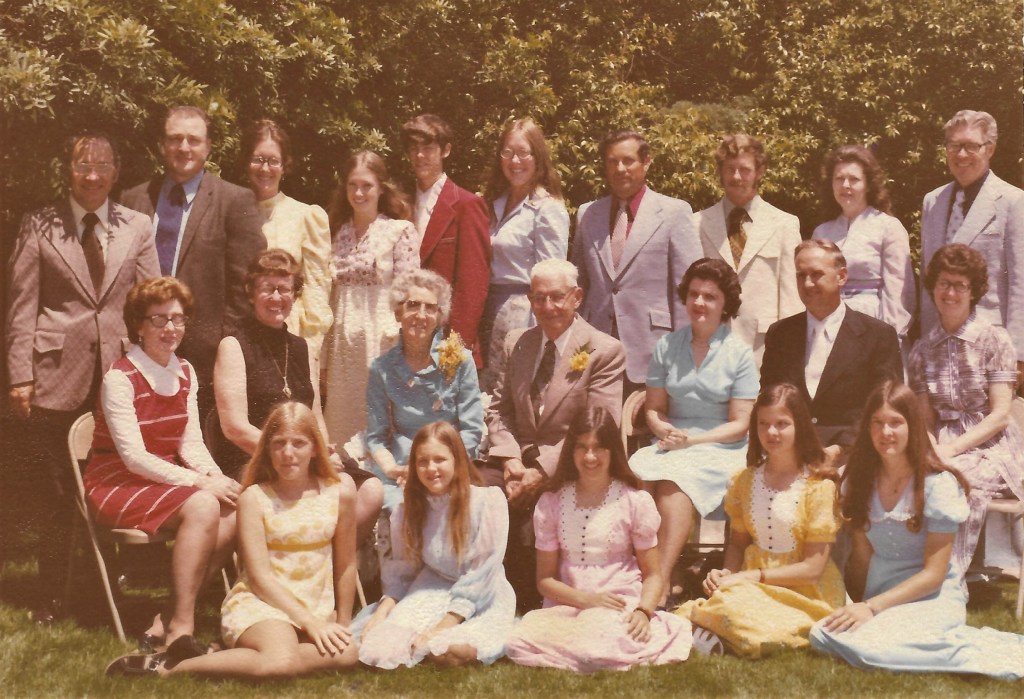
Grandpa & Grandma’s 50th Anniversary Celebration with their children and grandchildren.
“We cleaned the house yesterday. Sorry, you missed it.” Have I said this on a number of occasions? Yes. Yes, I have.
And also this:
“If you want to see us, come by anytime. If you want to see the house, call for an appointment.”
And (with apologies to quite a few of my fascinating friends who – beyond the scope of my comprehension – have discouragingly perfect homes), the patently untrue yet popular saying:
“Boring women have immaculate homes.”
Ever heard comments like this? I’ll bet they came from a family living in a small house. Cramming a busy family of five, two dogs, two cats, and a home business into our 1645 square foot house with one shared common area – a combined living/dining/office/project/kitchen space – definitely creates clutter! But, y’know, as long as it’s creative clutter . . . (cue eye roll).
On the upside, love does grow best in small houses, right? And I must admit that togetherness is probably some kind of blessing for us since we are mostly introverts who might otherwise be inclined to go the isolation route. Hah. No chance. Compromise and cooperation are not options here – they are mandatory life skills. We love each other and – aside from the occasional water, pillow, or tickle fight – we are not particularly fond of conflict, so we do our best to figure it out.
It’s pretty clear in God’s word that we show the love of Christ in us by loving others. We are to pursue maturity not separately, but together. Loving God = loving people. It’s not that we all get along beautifully all the time – not at all! We definitely have our high blood pressure moments. But I think living in a smaller space keeps us working on the issues, fighting for each other, loving each other, forgiving one another, and laughing together. I like to think that we would do all these things even living in a ginormous house, but the smaller home definitely provides motivation.
Now, I’m seriously off to clean. Really. I’m sincerely hoping to have the house reasonably in hand by noon Friday (so, basically, maybe by Saturday evening . . .) and the orderliness should last several whole minutes. If you plan to drop by, better not be late or you’ll miss it.
Christ tells us to forgive 70 x 7. That sounds like a lofty goal, but have you ever had to work so hard at forgiving – or been offended by the same person so repeatedly – that you actually counted up to that 490th time? So does that mean when we hit 491, we are exempt from forgiving? If so, I think there should be a revenge app that plays the theme from Jaws when the counter flips to 491.
Sometimes forgiveness is easy. But sometimes – well, sue me – sometimes I don’t feel particularly forgiving. Forgiving certain offenses rips at my brain and tears at my gut. My anger is especially fierce against hurts to my children or others I love.
But carrying unforgiveness causes me to hold anger in my soul and bitterness in my heart – the very same heart and soul that I have given to Jesus as a dwelling place within me. Who would want to live in that? Who would even ask anyone to live in that? There is a reason He tells us to love our enemies and pray for those who curse us. I have discovered it is quite difficult to hold a grudge against someone I pray for regularly – or even irregularly. When I close my eyes to pray for someone, God opens my heart to the fears and struggles causing that individual to be unkind or thoughtless. That makes me look at my own fears and failures, and then I see how much I share with that person, after all – and my heart breaks a little, surrendering my grip on the negativity. I cannot help but release my resentment and forgive. This does not relieve the hurt entirely, but the bitterness and the anger are lifted and compassion flows instead.
Not all offenses are major – some are light and easy to forgive. But others generate pain, and pain leads to anger, and I must wrestle fiercely with myself and God before finding peace in forgiving those offenses.
Offense can be fierce. Anger is fierce. Forgiveness must be fierce. There is nothing more fierce than battling the powers of Hell and death in order to offer grace. As a Christ-follower, I am called to be a living, breathing carrier of the very grace and forgiveness that was given to me – no matter the circumstances. So on the days when my heart burns with hurt, I remember that Christ burned with so very much more. My soul is humbled – my defenses are lowered. His mercy flows hard and fast through me. And the light of forgiveness bursts outward in a fierce healing rush.